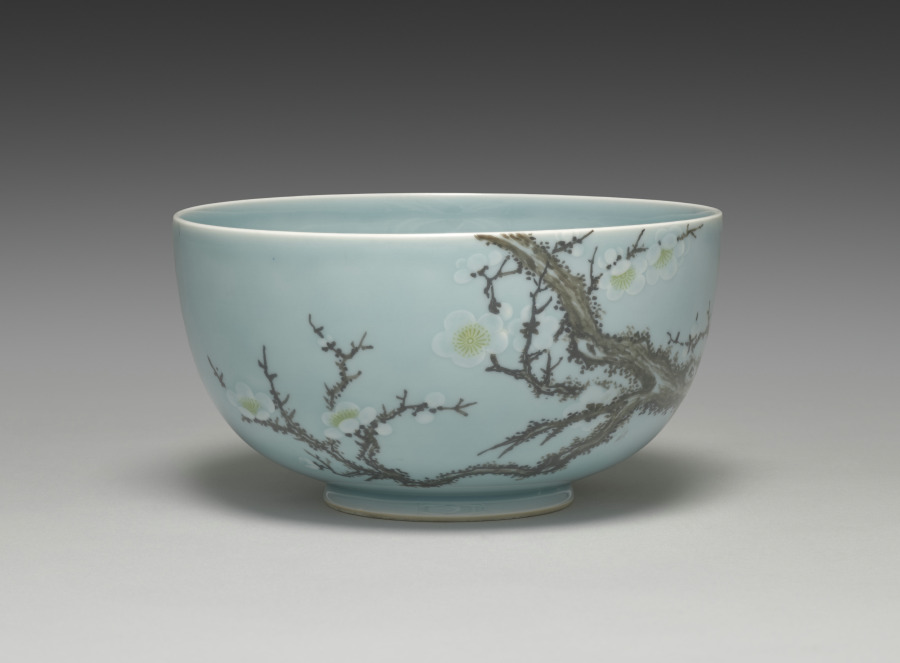
Sweets Bowl with Plum Tree
Seifū Yohei IV · 1914–46 · Cleveland Museum of Art
What did you think?
Guide
Adjust the guideNew to it · Medium
Nobody has listened to this guide yet. Making it takes about twenty seconds, and after that anyone can hear it straight away.
From the museum
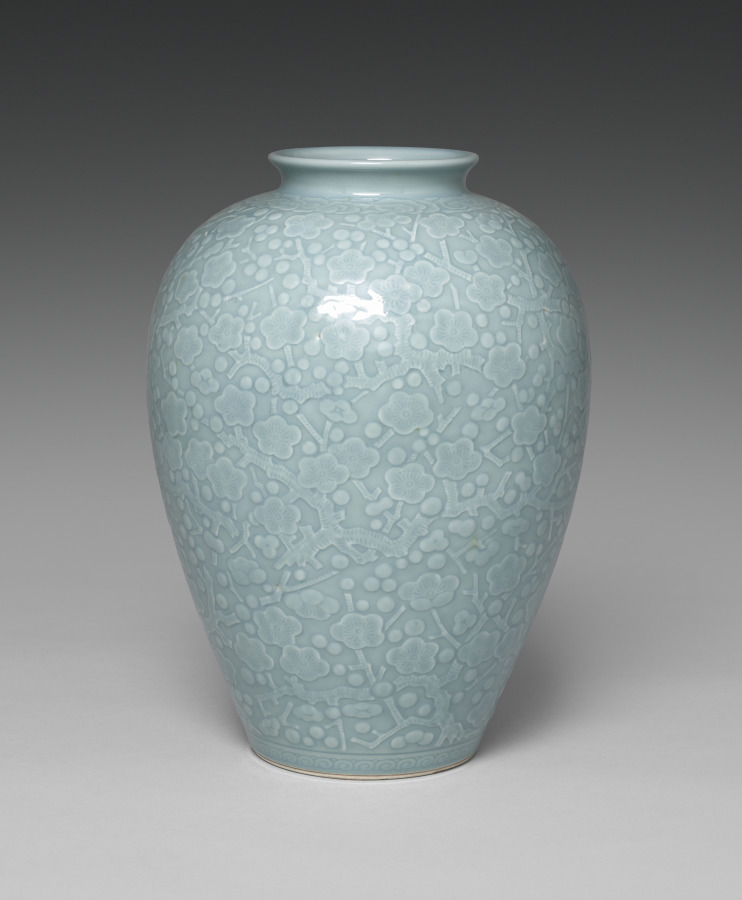
In Chinese culture, the plum symbolizes the virtue of perseverance. For his sweets bowl based on Qing dynasty (1644–1911) Chinese prototypes, Seifū Yohei IV first painted the gnarled boughs of a plum tree in iron oxide on the surface. Then he made the tree’s blossoms slightly raised by building up slip, or liquified clay. He painted their centers yellow. Before applying the blue glaze, he covered the blossoms with paper so that they remained white. Broad access to high-quality Chinese ceramics occasioned by the collapse of the Qing dynasty (1644–1911) and the dispersal of elite Chinese collections presented Seifū Yohei IV with models for both molded decoration and painted motifs.
The museum’s own description, in English. Licence: CC0
Ask about this work
Ask in your own words. The answer comes from what the museum has written about the work, and says so when that does not hold it.
Details
- Maker
- Seifū Yohei IV (Japanese, 1872–1951)
- Date
- 1914–46
- Medium
- Porcelain with underglaze color and modeled design
- Dimensions
- 11.5 x 21.5 cm (4 1/2 x 8 7/16 in.)
- Place of origin
- Japan
- Held by
- Cleveland Museum of Art, Cleveland · On view · 235A Japanese
- Credit line
- Gift of James and Christine Heusinger
Image: Cleveland Museum of Art, CC0