Just a moment
Just a moment
Katsushika Hokusai · 1831-32 · Art Institute of Chicago
A closer look, connecting key details with the work’s background.
Looking for this guide.
Here, a female demon (hannya) with horns holds the decap-itated head of a child; blood oozes from the wounds caused by her long fingernails. This image references the legend of Kishimojin, a goddess from early Buddhism known in Sanskrit as Hariti. Originally, this goddess was a terri-fying ogress who was determined to eat all of the babies in the town of Rajgir, India. The Buddha heard the pleas of the townspeople and hid one of Hariti’s own children, leading her to understand the grief she had caused. She then converted to Buddhism and was eventually accepted as a goddess and a protector of children. The Art Institute’s collection boasts one of the most well-preserved and appreciated editions of Katsushika Hok usa i’s One Hundred Ghost Tales series (1831–32). The artist apparently planned to produce a full hundred images, but the series was not completed and only five prints are known. The title refers to a game in which people would gather at night to tell scary stories, putting out a candle after each tale until the room was completely dark. These small-format works feature a bright-blue color made possible by Berlin blue pigment (often called “Prussian blue”), which had become affordable shortly before their production. Although this hue may seem cheery to us, Hokusai’s original audience would have associated it with death and the occult.
The museum’s own description, in English. Licence: CC BY 4.0
Save this work’s image and museum information on this device to read without a connection.
Ask in your own words. The answer comes from what the museum has written about the work, and says so when that does not hold it.
Image: Art Institute of Chicago, CC0
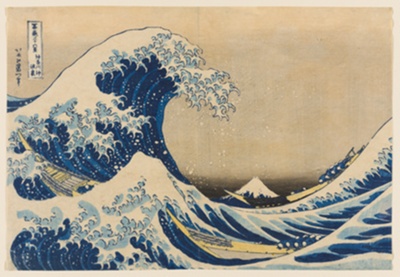 GuideUnder the Wave off Kanagawa (Kanagawa oki nami ura), also known as The Great Wave, from the series "Thirty-Six Views of Mount Fuji (Fugaku sanjurokkei)"Katsushika Hokusai · 1830/33
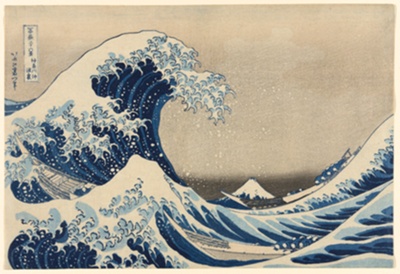 Under the Wave off Kanagawa (Kanagawa oki nami ura), also known as The Great Wave, from the series "Thirty-Six Views of Mount Fuji (Fugaku sanjūrokkei)"Katsushika Hokusai · 1830/33
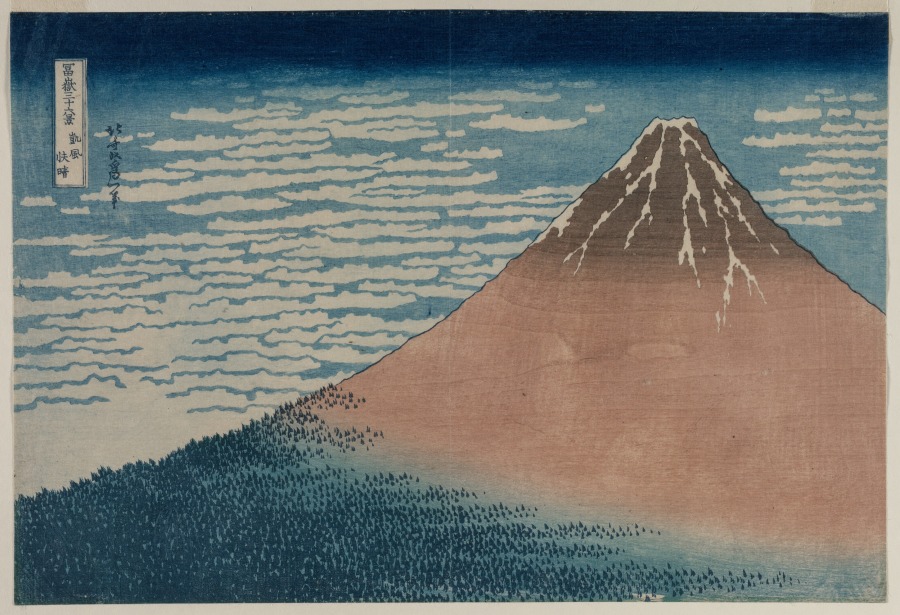 South Wind, Clear Sky, from Thirty-Six Views of Mount FujiKatsushika Hokusai · early 1830s