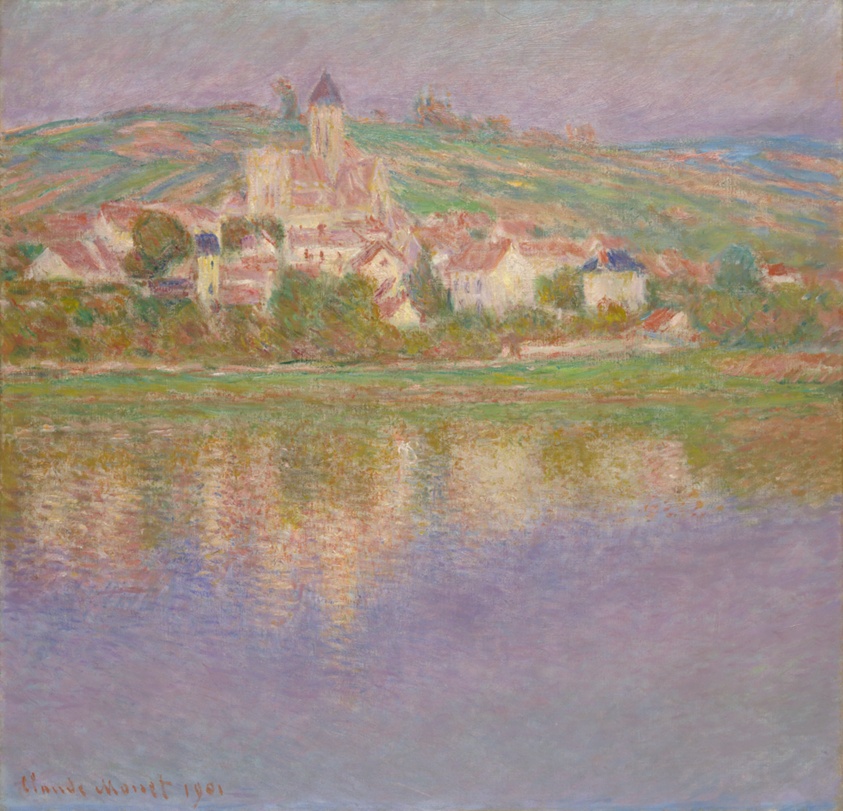
Vétheuil
Claude Monet · 1901 · Art Institute of Chicago
What did you think?
Guide
Adjust the guideNew to it · Medium
Nobody has listened to this guide yet. Making it takes about twenty seconds, and after that anyone can hear it straight away.
From the museum
In summer 1901 Claude Monet rented a modest house in Lavacourt, a small hamlet across the Seine from Vétheuil and not far from his property at Giverny, which he was in the process of expanding. He began 15 paintings of Vétheuil from the balcony of this rented home, all of which feature the same restricted view of the riverbank and town—punctuated by the church—and document the changes in light throughout the day. The Art Institute holds two paintings from the series, one from midday and another from sunset. Painted on nearly square canvases, Monet divided each composition in half, separating the town from its reflection. Rather than replicating the area’s topography or creating a convincing illusion of space, Monet emphasized the decorative over the descriptive qualities of this riverscape. His loose brushwork and subtle color transitions blur the distinctions between the scene’s various forms, dissolving the borders, for example, between the water and the land and the land and the sky. The shapes of the different buildings along the shoreline emerge through changes in the direction of brushstrokes and slight shifts in hue.
The museum’s own description, in English. Licence: CC BY 4.0
Ask about this work
Ask in your own words. The answer comes from what the museum has written about the work, and says so when that does not hold it.
Details
- Maker
- Claude Monet (French, 1840–1926)
- Date
- 1901
- Medium
- Oil on canvas
- Dimensions
- 90.2 × 93.4 cm (35 1/2 × 36 3/4 in.); Framed: 101 × 104.2 × 6.4 cm (39 3/4 × 41 × 2 1/2 in.)
- Place of origin
- France
- Held by
- Art Institute of Chicago, Chicago · On view · Gallery 243
- Credit line
- Mr. and Mrs. Lewis Larned Coburn Memorial Collection
Image: Art Institute of Chicago, CC0