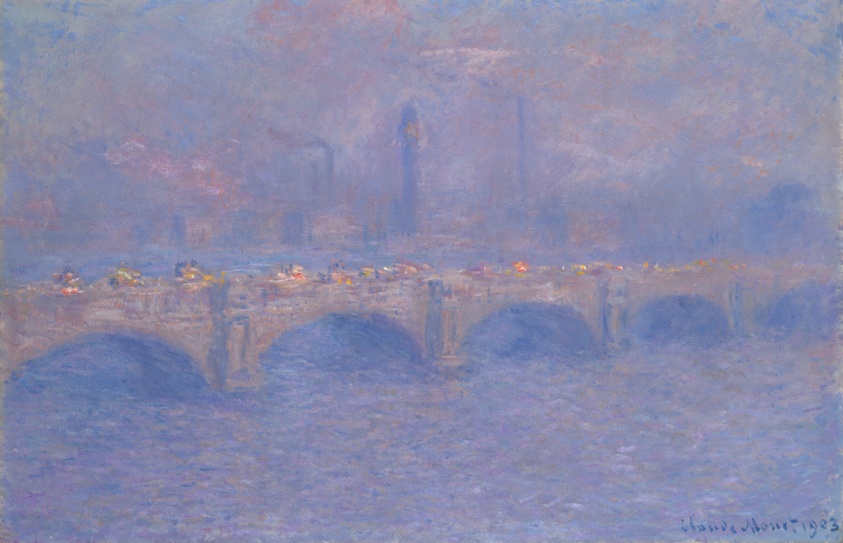
Waterloo Bridge, Sunlight Effect
Claude Monet · 1903 · Art Institute of Chicago
What did you think?
Guide
Adjust the guideNew to it · Medium
Nobody has listened to this guide yet. Making it takes about twenty seconds, and after that anyone can hear it straight away.
From the museum
If not for the fog, Claude Monet once remarked, “London wouldn’t be a beautiful city. It’s the fog that gives it its magnificent breadth.” While working on his London Series, he rose early every day to paint Waterloo Bridge in the morning, moving on to Charing Cross Bridge at midday and in the afternoon. He observed both motifs from his fifth-floor window at the Savoy Hotel. The Art Institute’s two Waterloo Bridge paintings are dated 1900 and 1903, but both were likely begun in 1900 and dated only when Monet felt that they were finished. He worked on all of his London paintings in his studio in Giverny, refusing to send any of them to his dealer until he was satisfied with them as an ensemble.
The museum’s own description, in English. Licence: CC BY 4.0
Ask about this work
Ask in your own words. The answer comes from what the museum has written about the work, and says so when that does not hold it.
Details
- Maker
- Claude Monet (French, 1840–1926)
- Date
- 1903
- Medium
- Oil on canvas
- Dimensions
- 65.7 × 101 cm (25 7/8 × 39 3/4 in.); Framed: 88.9 × 123.2 × 10.8 cm (35 × 48 1/2 × 4 1/4 in.)
- Place of origin
- France
- Held by
- Art Institute of Chicago, Chicago · On view · Gallery 243
- Credit line
- Mr. and Mrs. Martin A. Ryerson Collection
Image: Art Institute of Chicago, CC0