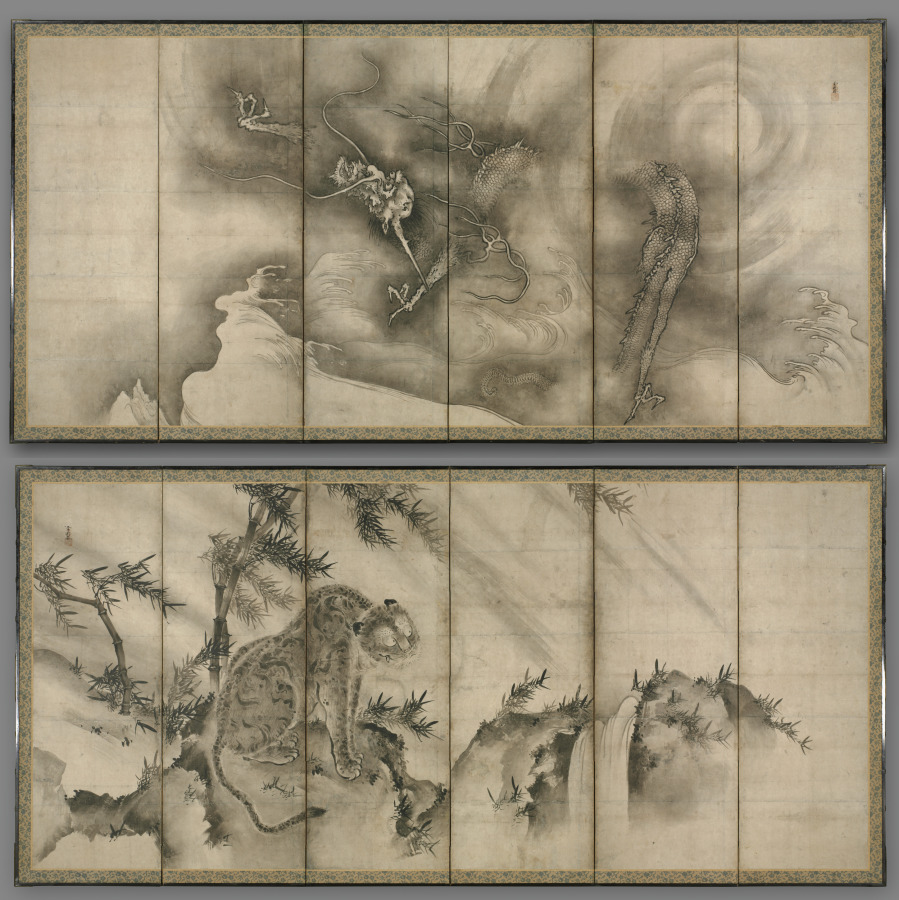
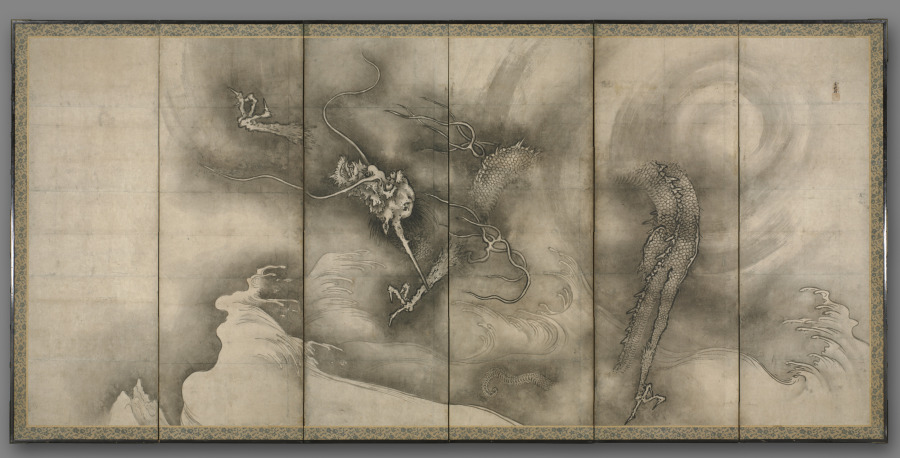
Dragon and Tiger
Sesson Shūkei · c. 1546–56 · Museo de Arte de Cleveland
Guía
Ajustar la guíaPrincipiante · Media
Nadie ha escuchado todavía esta guía. Prepararla lleva unos veinte segundos y, después, cualquiera podrá escucharla al momento.
Texto del museo
In Chinese cosmology, the tiger's roar is said to produce wind. In Chinese paintings, the tiger is often shown with a dragon, who creates rain clouds. Together, they represent the balancing forces of the universe. Chinese presentations of the theme, often in hanging scroll format, provided the basic composition for the pair of screens to which this one belongs. Although the theme of this painting derives from Chinese philosophy and pictorial culture, Sesson's tiger is likely modeled after Korean prototypes of the Joseon period circulating in Japan.
Descripción original del museo, en inglés. Licencia: CC0
¿Qué te ha parecido?
Guarda la imagen y la información del museo en este dispositivo para leerlas sin conexión.
Pregunta sobre esta obra
Pregunta con tus propias palabras. La respuesta sale de lo que el museo ha escrito sobre la obra, y lo dice cuando ahí no está.
Detalles
- Autor
- Sesson Shūkei (Japanese, c. 1492–c. 1577)
- Fecha
- c. 1546–56
- Técnica
- One of a pair of six-panel folding screens; ink on paper
- Dimensiones
- Painting: 157.3 x 339 cm (61 15/16 x 133 7/16 in.); Framed: 172.3 x 354 cm (67 13/16 x 139 3/8 in.)
- Lugar de origen
- Japan
- Colección
- Museo de Arte de Cleveland, Cleveland · No expuesta
- Procedencia
- Purchase from the J. H. Wade Fund
Imagen: Cleveland Museum of Art, CC0