Un momento, por favor
Un momento, por favor
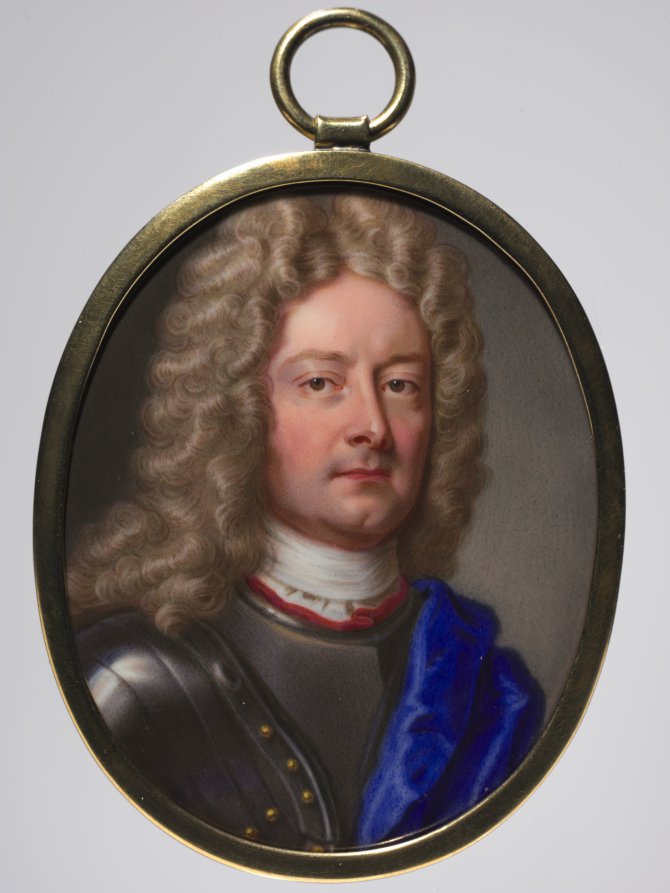
Christian Friedrich Zincke · c. 1735 · Museo de Arte de Cleveland
Una mirada más cercana que conecta los detalles principales con el contexto de la obra.
Buscando esta guía.
The unknown sitter's shoulders are turned to the right, and he is painted almost full face. He wears a bright blue velvet coat with covered buttons, deep yellow embroidered waistcoat, and white stock collar with double lace frill down the front. His powdered wig falls to his shoulders. He has gray eyes and is clean shaven with rosy cheeks, and the background is dark brown. The miniature is set in a gold locket-style frame. The back displays a lock of dark brown hair inside a border of bright blue foiled glass—a popular framing style for miniatures in the late eighteenth and early nineteenth centuries and, therefore, surely a later addition. Since the publication of the Greene collection catalogue in 1951, the attribution of this miniature has been disputed, with experts alternately suggesting Christian Friedrich Zincke and possibly Charles Boit (1663–1727). The evidence in favor of Zincke, however, is far stronger than it is for Boit, who had not worked in England for over a decade before his death in 1727, several years before the most plausible date for this portrait. Among Zincke’s hallmarks are lips painted two different colors—here, purplish pink on top and orange on the bottom—a practice that became increasingly pronounced later in his career. This portrait also exhibits Zincke’s characteristic treatment of the eyes during this period: he framed the eyes with individually painted black dots to represent eyelashes. The counter-enamel is not inscribed but has the smooth appearance of the counter-enamels customarily associated with Zincke’s later career. A miniature identical in all but the facial features appeared at Christie’s, London, in 2004. Zincke often used this costume consisting of a blue (or sometimes brown) velvet jacket with covered buttons, yellow embroidered waistcoat, and frilled lace cravat. An example that sold at Christie’s in 1996 is signed and dated 1734. Another closely related and unsigned example by Zincke in the Metropolitan Museum of Art has been dated to c. 1745, indicating when this attire was frequently employed by Zincke’s studio. Unlike fragile portrait miniatures painted in watercolor on vellum or ivory, which are prone to cracking, fading, and flaking, enamels are resilient, impervious to the effects of light, and retain their striking original colors over time.
Descripción original del museo, en inglés. Licencia: CC0
Guarda la imagen y la información del museo en este dispositivo para leerlas sin conexión.
Pregunta con tus propias palabras. La respuesta sale de lo que el museo ha escrito sobre la obra, y lo dice cuando ahí no está.
Imagen: Cleveland Museum of Art, CC0