Un momento, por favor
Un momento, por favor
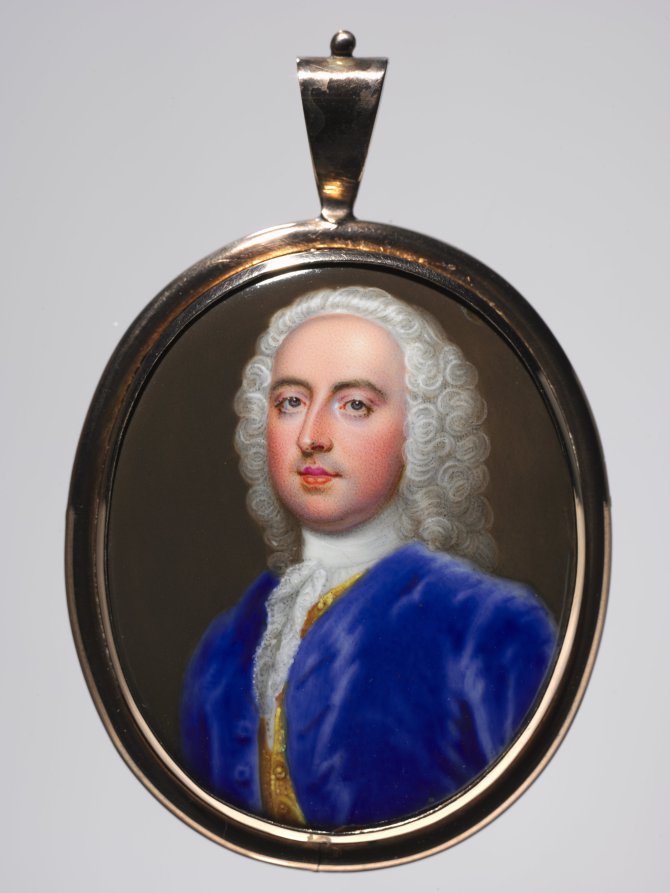
Christian Friedrich Zincke · 1715 · Museo de Arte de Cleveland
Una mirada más cercana que conecta los detalles principales con el contexto de la obra.
Buscando esta guía.
Unlike fragile portrait miniatures painted in watercolor on vellum or ivory, which are prone to cracking, fading, and flaking, enamels are resilient, impervious to the effects of light, and retain their striking original colors over time. Partly for this reason enamel was considered ideal for reproducing famous paintings and treasured portraits in a reduced and luminous form. The complicated and labor-intensive process of enameling required the artist to fire numerous layers of colored metal oxide at different temperatures, which made it difficult to produce a faithful portrait likeness, though masters of the medium were able create portraits of remarkable subtlety imbued with the sitter's personality. The heyday of enamel painting was the late 1600s and early 1700s. Among the enamel specialists was Zincke, who worked in England where he was patronized by Queen Anne, King George I, and King George II. Although miniatures are often regarded as a private art form exchanged between loved ones, the nature of this enamel was likely political.
Descripción original del museo, en inglés. Licencia: CC0
Guarda la imagen y la información del museo en este dispositivo para leerlas sin conexión.
Pregunta con tus propias palabras. La respuesta sale de lo que el museo ha escrito sobre la obra, y lo dice cuando ahí no está.
Imagen: Cleveland Museum of Art, CC0