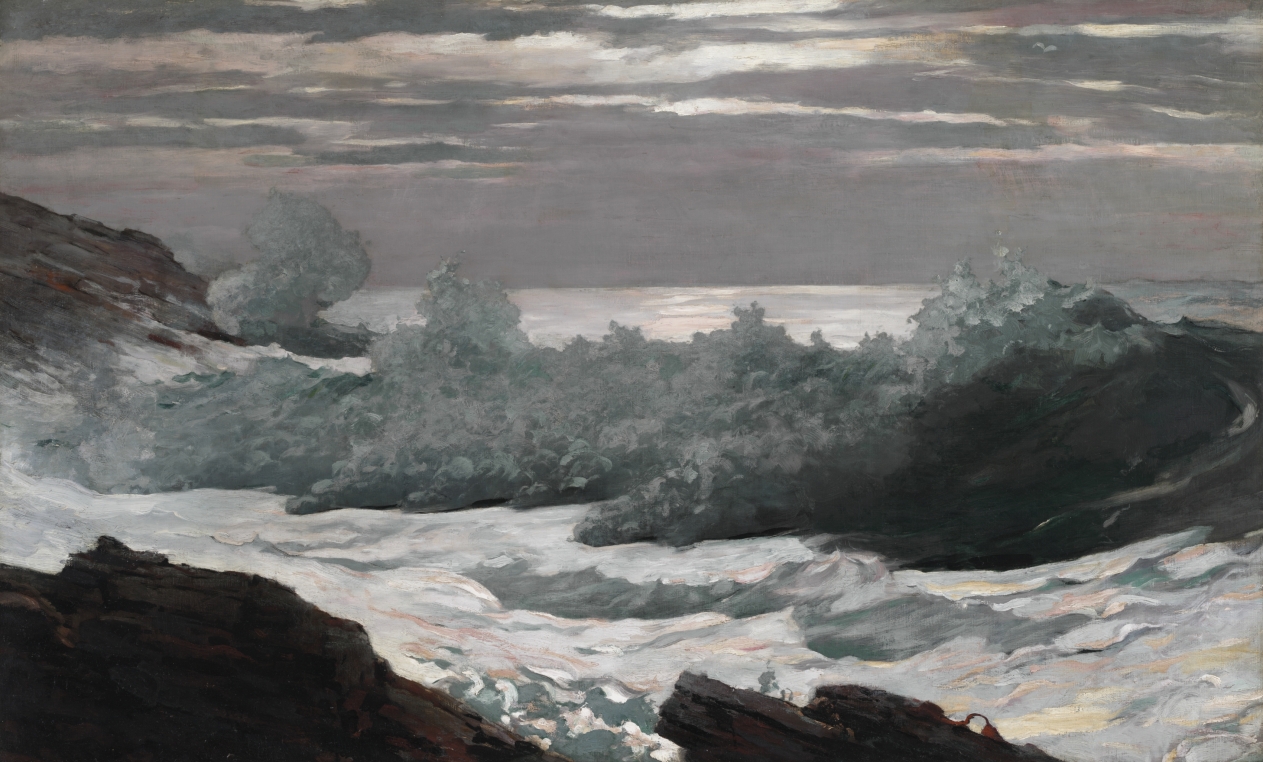
Prout's Neck, Breakers
Guía
Ajustar la guíaPrincipiante · Media
Nadie ha escuchado todavía esta guía. Prepararla lleva unos veinte segundos y, después, cualquiera podrá escucharla al momento.
Texto del museo
Homer’s decision to move to Maine in 1883 presumably indicated his desire to live close to nature—Prout’s Neck was a peninsula known for its rocky coastline and dramatic views of the Atlantic Ocean. Prout’s Neck, Breakers, later the model for the monumental oil painting Early Morning after a Storm at Sea, shows the artist’s continued fascination with the power of the sea. However, unlike his earlier marine works, this and other watercolors made at Prout’s Neck are usually devoid of human activity, exploring nature’s grandeur in its many manifestations. This work also exemplifies important aspects of Homer’s technique as a watercolorist, including the way he layered strokes of color—using a range of light and dark blues—to create the depth and force of the breaking waves. He used the white of the paper to produce a brilliant sheen on the sea, juxtaposed with a hazy sky above.
Descripción original del museo, en inglés. Licencia: CC BY 4.0
¿Qué te ha parecido?
Guarda la imagen y la información del museo en este dispositivo para leerlas sin conexión.
Pregunta sobre esta obra
Pregunta con tus propias palabras. La respuesta sale de lo que el museo ha escrito sobre la obra, y lo dice cuando ahí no está.
Detalles
- Autor
- Winslow Homer, American, 1836-1910
- Fecha
- 1883
- Técnica
- Watercolor, with blotting and sanding, over charcoal, on moderately thick, moderately textured, ivory wove paper
- Dimensiones
- 38.1 × 54.6 cm (15 × 21 1/2 in.)
- Lugar de origen
- United States
- Colección
- Instituto de Arte de Chicago, Chicago · No expuesta
- Procedencia
- Mr. and Mrs. Martin A. Ryerson Collection
Imagen: Art Institute of Chicago, CC0