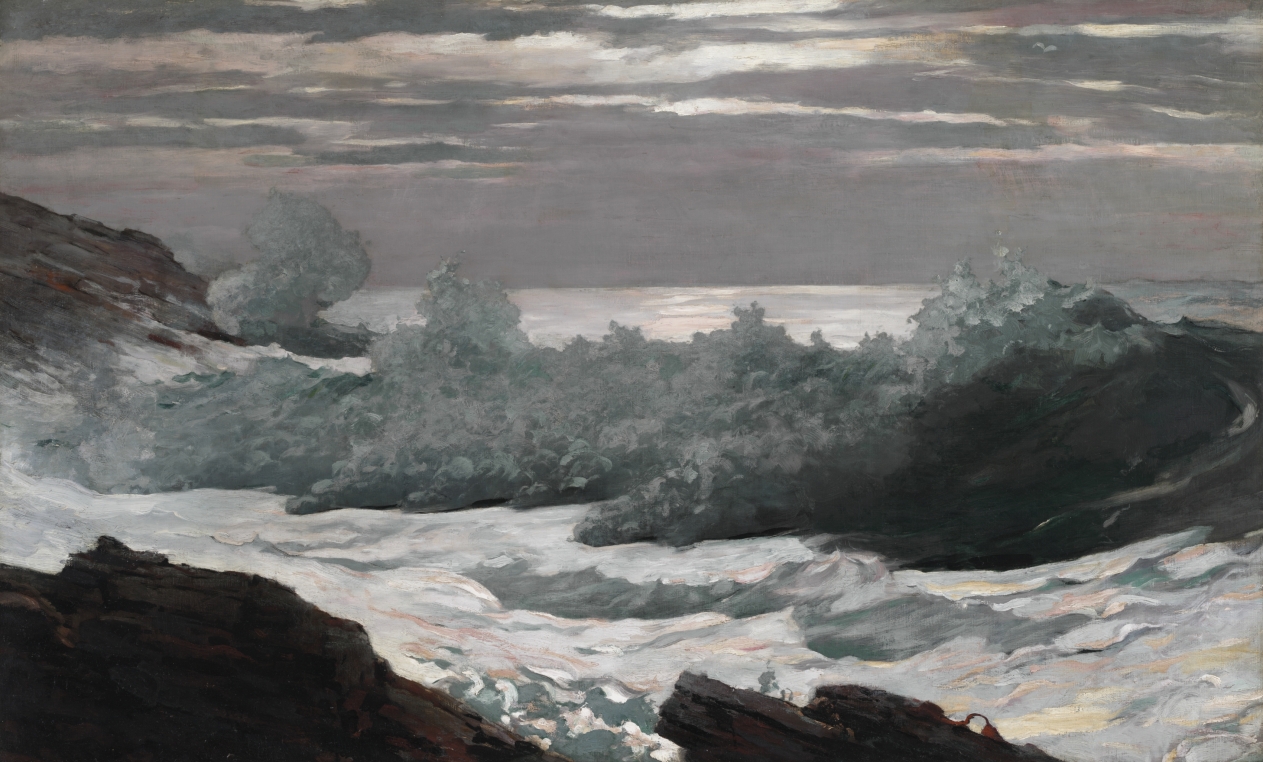
Prout's Neck, Breaking Wave
Guía
Ajustar la guíaPrincipiante · Media
Nadie ha escuchado todavía esta guía. Prepararla lleva unos veinte segundos y, después, cualquiera podrá escucharla al momento.
Texto del museo
Philip Beam has identified the site for Prout’s Neck, Breaking Wave as “the shoreline a little above water’s edge in the vicinity of Cannon Rock, looking toward High Cliff,” adding that Homer “fished from this point almost daily during the summer and fall and must have seen such waves "a thousand times" (Beam 1966, n.p.). Homer’s familiarity with the site is born out by the techniques that he used to capture the relentless churning movement of the massive wave. Although he used very little graphite in this work, he mapped out the frothy whites of the wave by making staccato marks with resist, probably using chalk for this purpose. Homer used almost every trick he knew to achieve the varied textures of water, shore, and sky, including layering, blotting, rewetting, and scraping. Although carefully planned and carried out, the final effect is vigorous and immediate.
Descripción original del museo, en inglés. Licencia: CC BY 4.0
¿Qué te ha parecido?
Guarda la imagen y la información del museo en este dispositivo para leerlas sin conexión.
Pregunta sobre esta obra
Pregunta con tus propias palabras. La respuesta sale de lo que el museo ha escrito sobre la obra, y lo dice cuando ahí no está.
Detalles
- Autor
- Winslow Homer, American, 1836-1910
- Fecha
- 1887
- Técnica
- Transparent watercolor, with touches of opaque watercolor, rewetting, blotting and scraping, over resist and traces of graphite, on medium weight, moderately textured, ivory wove paper, laid down on cream wove paper
- Dimensiones
- 38 × 54.4 cm (15 × 21 7/16 in.)
- Lugar de origen
- United States
- Colección
- Instituto de Arte de Chicago, Chicago · No expuesta
- Procedencia
- Mr. and Mrs. Martin A. Ryerson Collection
Imagen: Art Institute of Chicago, CC0