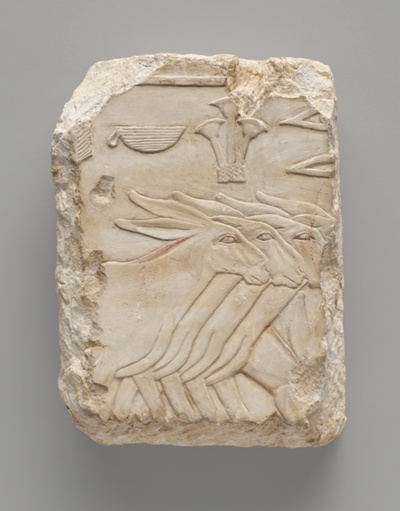
Trial Piece with Hieroglyphs
Ancient Egyptian · Early Ptolemaic Period, about 300 BCE · Instituto de Arte de Chicago
Guía
Ajustar la guíaPrincipiante · Media
Buscando esta guía.
Texto del museo
Artists used stone remnants left over from larger works to practice carving hieroglyphic signs and decorative elements. Here, the profiles of a man and a feline deity may be studies for larger works. Two hieroglyphs also appear on the thin slab. First used around 3000 BCE, ancient Egyptian hieroglyphs used images to convey sounds and meaning in writing. The undulating horned viper at the bottom of this piece represents the sound f, while the large owl in the center has the phonetic value m.
Descripción original del museo, en inglés. Licencia: CC BY 4.0
¿Qué te ha parecido?
Guarda la imagen y la información del museo en este dispositivo para leerlas sin conexión.
Pregunta sobre esta obra
Pregunta con tus propias palabras. La respuesta sale de lo que el museo ha escrito sobre la obra, y lo dice cuando ahí no está.
Detalles
- Autor
- Egyptian
- Fecha
- Early Ptolemaic Period, about 300 BCE
- Técnica
- Granite
- Dimensiones
- 23.4 × 14 × 2.5 cm (9 3/8 × 5 1/2 × 1 in.)
- Lugar de origen
- Egypt
- Colección
- Instituto de Arte de Chicago, Chicago · En sala · Gallery 50
- Procedencia
- Museum Purchase Fund
Imagen: Art Institute of Chicago, CC0
Más de Ancient Egyptian
GuíaCoffin and Mummy of PaankhaenamunAtaúd y momia de PaankhaenamunAncient Egyptian · Third Intermediate Period, Dynasty 22, reign of Osorkon I (about 924–889 BCE)
GuíaStela of Amenemhat and HemetEstela de Amenemhat y HemetAncient Egyptian · Middle Kingdom, early Dynasty 12, about 1956–1877 BCE
Fragment of a Stela of NeferhotepAncient Egyptian · New Kingdom, mid-Dynasty 19, about 1240-1195 BCE