잠시만 기다려 주세요
잠시만 기다려 주세요
Katsushika Hokusai · 1831-32 · 시카고 미술관
작품의 주요 특징과 배경을 연결해 살펴봐요.
가이드를 찾고 있습니다.
This pale-skinned head emerging from a worn paper lantern is a depiction of Oiwa, a character from Yotsuya Kaidan, a famous Japanese ghost play (kaidan mono). In the story Oume, a woman who wants to steal Oiwa’s husband, sends her a topical poison disguised as a face cream. The poison immediately scars Oiwa, and her eye begins to droop, as seen in the center of the image here. When she realizes the deception, Oiwa becomes hysterical and accidentally kills herself. After her death, she seeks revenge on not just Oume but also her husband and others. The inscription on the lantern begs us to pray for her soul. The Art Institute’s collection boasts one of the most well-preserved and appreciated editions of Katsushika Hok usa i’s One Hundred Ghost Tales series (1831–32). The artist apparently planned to produce a full hundred images, but the series was not completed and only five prints are known. The title refers to a game in which people would gather at night to tell scary stories, putting out a candle after each tale until the room was completely dark. These small-format works feature a bright-blue color made possible by Berlin blue pigment (often called “Prussian blue”), which had become affordable shortly before their production. Although this hue may seem cheery to us, Hokusai’s original audience would have associated it with death and the occult.
미술관이 쓴 설명 원문입니다(영어). 라이선스: CC BY 4.0
작품 이미지와 미술관 정보를 이 기기에 저장해 인터넷 연결 없이 읽어 보세요.
궁금한 것을 내 말로 물어보세요. 미술관이 이 작품에 대해 쓴 글에서 답을 찾고, 거기에 없으면 없다고 말합니다.
이미지: Art Institute of Chicago, CC0
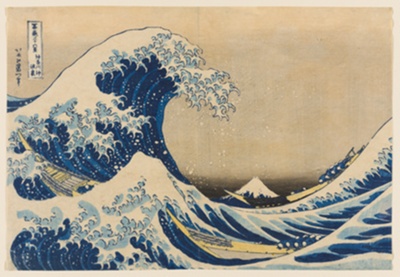 해설Under the Wave off Kanagawa (Kanagawa oki nami ura), also known as The Great Wave, from the series "Thirty-Six Views of Mount Fuji (Fugaku sanjurokkei)"가나가와 앞바다의 거대한 파도Katsushika Hokusai · 1830/33
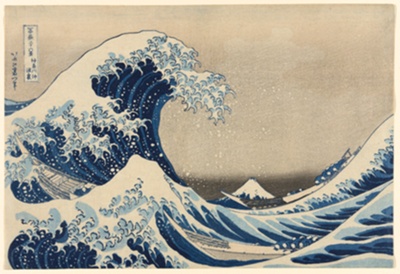 Under the Wave off Kanagawa (Kanagawa oki nami ura), also known as The Great Wave, from the series "Thirty-Six Views of Mount Fuji (Fugaku sanjūrokkei)"Katsushika Hokusai · 1830/33
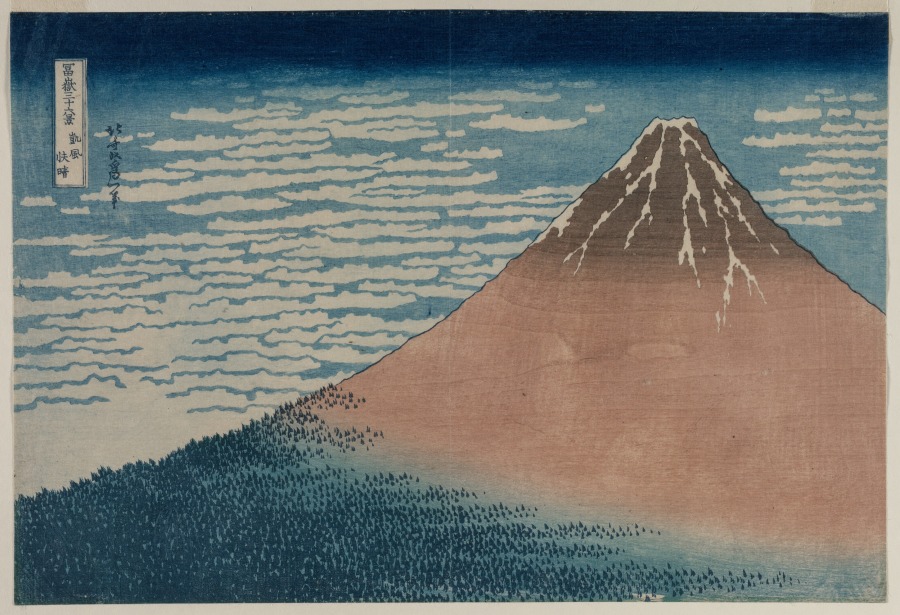 South Wind, Clear Sky, from Thirty-Six Views of Mount FujiKatsushika Hokusai · early 1830s