잠시만 기다려 주세요
잠시만 기다려 주세요
Peter Paul Rubens · c. 1637–38 · 클리블랜드 미술관
작품의 주요 특징과 배경을 연결해 살펴봐요.
가이드를 찾고 있습니다.
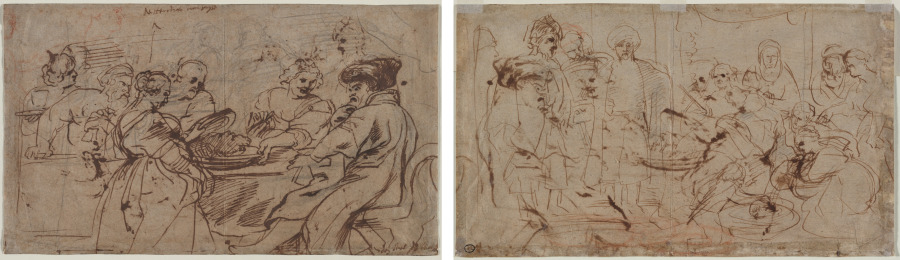
Peter Paul Rubens had a large studio in Antwerp and used drawing to prepare for large paintings as well as to direct the many pupils who assisted him. Striking in its immediacy, the drawing on the recto of this sheet of paper is a preparatory study for the Feast of Herod painting now at the Scottish National Gallery in Edinburgh. Herod, wearing a large cap and wrapped in a mantle, shrinks back in horror as Salome uncovers a charger that holds the head of Saint John the Baptist. Smiling, Herodias grabs the platter with her left hand and, in a chilling detail, gestures toward the charger with a fork. Rubens wrote what is usually interpreted as “Herodias somewhat higher” at the top of the sheet. The verso of the sheet depicts a sketch for another story featuring a change of fortune at the hands of a vengeful woman, Tomyris with the Head of Cyrus. Rubens made two paintings of the subject (now in Paris and Boston). A rare theme, the story tells of Queen Tomyris who, avenging the death of her son in battle, collects the head of his murderer Cyrus in a bag of human blood. Tomyris is shown seated under a canopy holding a scepter, while the servants before her handle Cyrus’s head. Rubens wrote “plus spatij” (more space) in the center of the sheet. The two stories that Rubens depicted on the front and back of this sheet of paper each feature a gruesome death, the result of revenge at the hands of a powerful woman.
미술관이 쓴 설명 원문입니다(영어). 라이선스: CC0
작품 이미지와 미술관 정보를 이 기기에 저장해 인터넷 연결 없이 읽어 보세요.
궁금한 것을 내 말로 물어보세요. 미술관이 이 작품에 대해 쓴 글에서 답을 찾고, 거기에 없으면 없다고 말합니다.
이미지: Cleveland Museum of Art, CC0