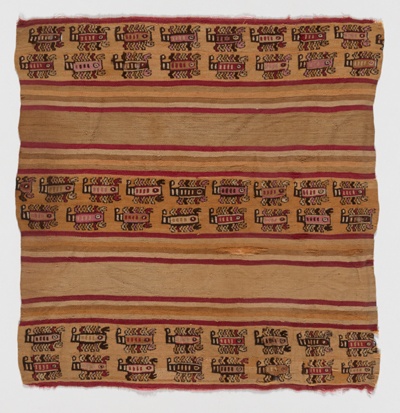
Border Fragment
Chancay · 1000-1476 · Art Institute of Chicago
Guide
Adjust the guideNew to it · Medium
Looking for this guide.
From the museum
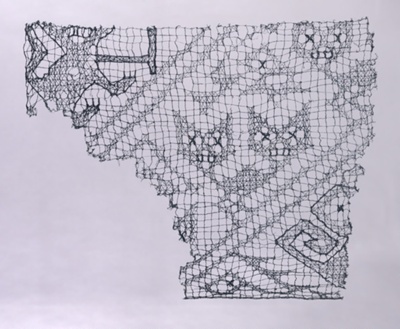
The Chancay primarily occupied the Huaura, Chancay, and Chillón river valleys along the central coast of Peru. Despite the fact that numerous examples of Chancay artwork survive, little is known about their culture and textile tradition. However, the quality of Chancay textiles demonstrates the importance of the artform within this enigmatic community. Rows of venomous scorpions scurry across the central area of this fragment, accompanied by a band of interlocking birds. These noctrnal arachnids are associated with death, war, and the supernatural realm and likely reference the fearsome warriors who ruled over the different Chancay communities.
The museum’s own description, in English. Licence: CC BY 4.0
What did you think?
Save this work’s image and museum information on this device to read without a connection.
Ask about this work
Ask in your own words. The answer comes from what the museum has written about the work, and says so when that does not hold it.
Details
- Maker
- Chancay, Central coast, Peru
- Date
- 1000-1476
- Medium
- Cotton and wool (camelid), bands of plain weave, slit tapestry weave with wrapping outlining wefts, and three-color complementary weft weave; edged with plain weave extended weft loop fringe
- Dimensions
- 34.2 × 39.3 cm (13 1/2 × 15 1/2 in.)
- Place of origin
- Peru
- Held by
- Art Institute of Chicago, Chicago · Not on view
- Credit line
- Kate S. Buckingham Endowment
Image: Art Institute of Chicago, CC0