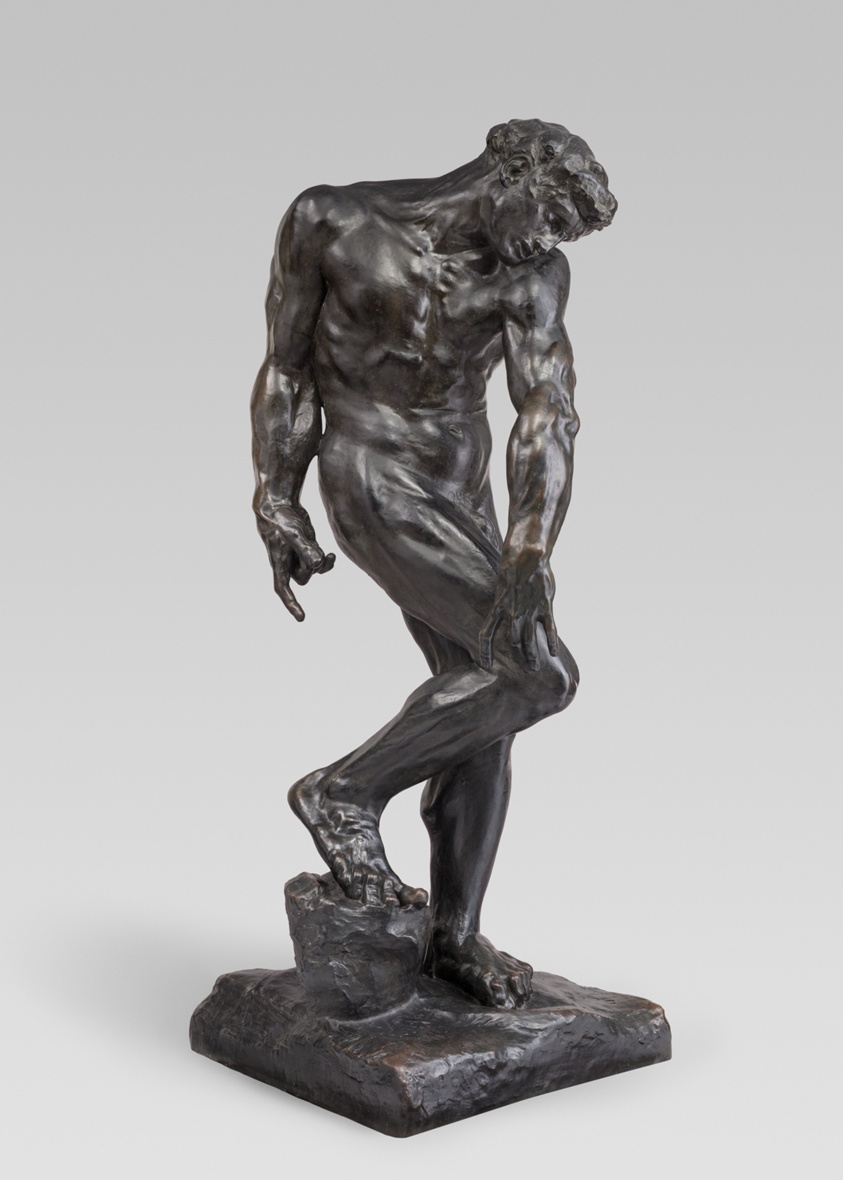
Adam
Auguste Rodin · Modeled 1881, cast c. 1924 · Art Institute of Chicago
What did you think?
Guide
4 chapters · about 2 minAdjust the guideNew to it · Medium
A Body in Torment
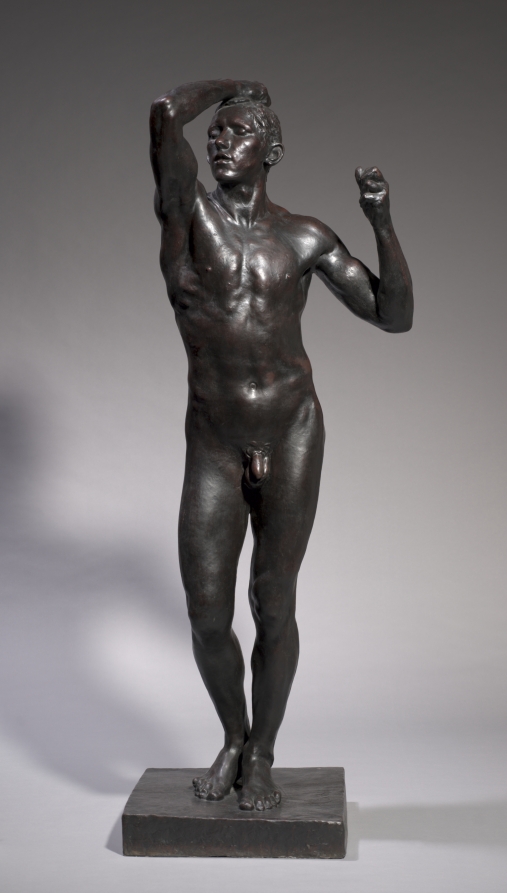
This is a nearly life-size bronze figure of Adam, the first man in the Bible. He stands almost two metres tall, on a base about as wide as his body. He is nude, and the metal is a dark, glossy brown. Look at how his body twists. His torso turns one way while his head and limbs pull another, so he seems caught between collapsing and rising. His right arm reaches out, and his left arm bends sharply across his body. The whole figure feels heavy with pain and effort.
Two Arms, Two Gestures
Look first at the right arm. It stretches outward, and this is the gesture of receiving life. Now find the left arm, which turns in an exaggerated, almost twisted way. Notice how unnatural that bend is. It was meant to push the feeling of distress further. Then let your eye travel down the whole body, from the head to the feet, and follow the twist. The strain seems to run through every limb, so that the pose itself becomes the expression of suffering.
Made for the Gates of Hell
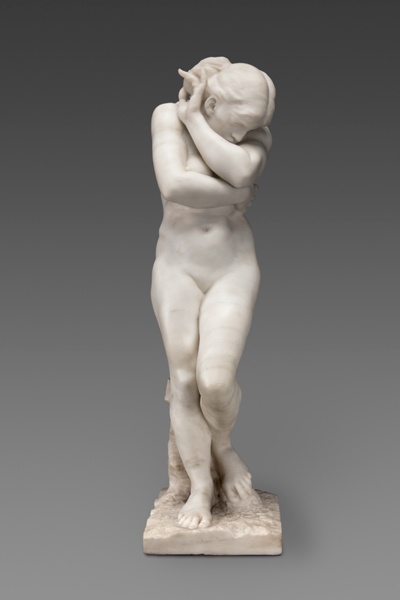
Auguste Rodin modeled Adam in 1881. This bronze was cast around 1924, after his lifetime. Adam was meant to stand beside a figure of Eve, on either side of a huge bronze doorway. The French government had commissioned that doorway for a museum of decorative arts in Paris. Rodin called it The Gates of Hell, and took its theme from Inferno, a fourteenth-century poem by Dante. The museum was never built, and the doorway was not finished as first planned. It was cast in bronze only in 1938, and placed at the entrance to the Musée Rodin in Paris.
Borrowing from Michelangelo
Rodin looked to Italian masters for this figure. The pose comes from Michelangelo's Adam on the Sistine Chapel ceiling, painted between 1508 and 1512. Rodin turned that reclining figure around and moved its gesture of receiving life into the sculpture's right arm. The twisting left arm comes from Michelangelo's sculpture of the dead Christ in his Pietà. Here Adam's agonized body shows the suffering that followed original sin, the first disobedience in the Bible. Look once more at that outstretched right arm, and ask whether it seems to receive a gift or to suffer a burden.
This guide was written by AI from the description published by Art Institute of Chicago. Licence: CC BY 4.0
Ask about this work
Ask in your own words. The answer comes from what the museum has written about the work, and says so when that does not hold it.
Details
- Maker
- Auguste Rodin (French, 1840–1917)
- Date
- Modeled 1881, cast c. 1924
- Medium
- Bronze with dark brown patina
- Dimensions
- 198.1 × 73.7 cm (78 × 29 in.); Base: 76.2 × 73.7 cm (30 × 29 in.)
- Place of origin
- France
- Held by
- Art Institute of Chicago, Chicago · On view · Gallery 200
- Credit line
- Gift of Robert Allerton
Image: Art Institute of Chicago, CC0