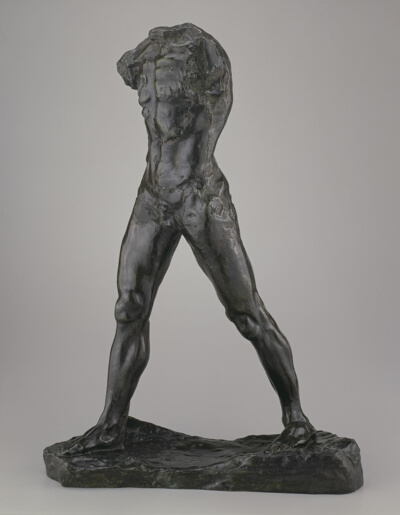
Eve after the Fall
Auguste Rodin · Modeled 1883, carved c. 1886 · Art Institute of Chicago
Guide
Adjust the guideNew to it · Medium
Looking for this guide.
From the museum
Auguste Rodin’s sculpture Eve owes its genesis to The Gates of Hell, the artist’s major commission from the French government in 1880. The associations posed by the sculptural portals of that project led Rodin back to the art of Lorenzo Ghiberti and Michelangelo, particularly their depiction of biblical stories from the book of Genesis. A number of elements from the Gates—such as The Thinker, Adam, and Eve—gradually evolved into independent works. In particular, Eve recalls the most sculptural of Renaissance paintings: Michelangelo’s panels from the Sistine Chapel Ceiling and Masaccio’s Expulsion from the Garden of Eden. Its naturalism shocked critics when it was first exhibited, since Eve seemed to them more like a flesh-and-blood woman than an idealized creation.
The museum’s own description, in English. Licence: CC BY 4.0
What did you think?
Save this work’s image and museum information on this device to read without a connection.
Ask about this work
Ask in your own words. The answer comes from what the museum has written about the work, and says so when that does not hold it.
Details
- Maker
- Auguste Rodin (French, 1840–1917)
- Date
- Modeled 1883, carved c. 1886
- Medium
- Marble
- Dimensions
- 76.2 × 27.4 × 21 cm (30 × 11 × 8 1/4 in.)
- Place of origin
- France
- Held by
- Art Institute of Chicago, Chicago · On view · Gallery 243
- Credit line
- Mr. and Mrs. Martin A. Ryerson Collection
Image: Art Institute of Chicago, CC0