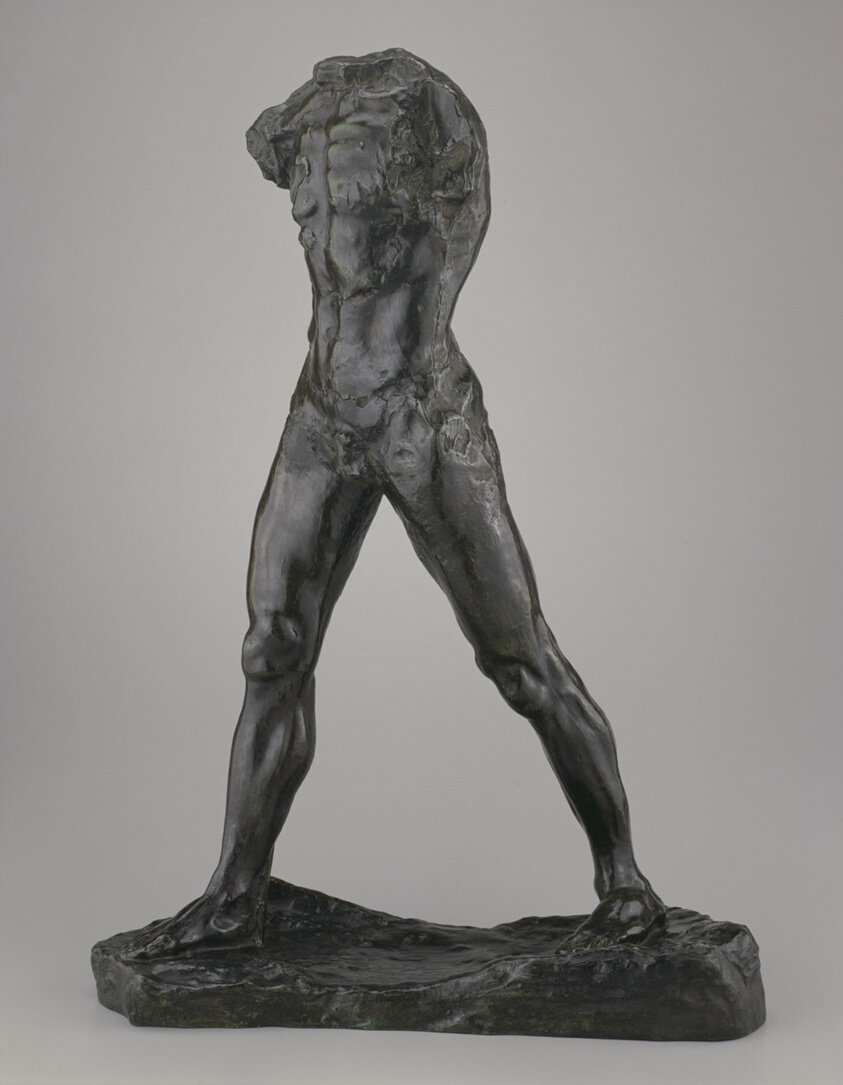
The Walking Man
Auguste Rodin · Modeled 1877–1900, cast before 1917 · Art Institute of Chicago
What did you think?
Guide
Adjust the guideNew to it · Medium
Nobody has listened to this guide yet. Making it takes about twenty seconds, and after that anyone can hear it straight away.
From the museum
The Walking Man originated from one of Auguste Rodin’s early successes, his life-size Saint John the Baptist Preaching of 1878. Rodin made separate plaster studies of the sculpture’s components, and much later he returned to the legs of the Baptist, grafting onto them a torso from another composition. In 1900 he exhibited a half-life-size version of this work in plaster, and it made a deep impression on younger artists, notably Henri Matisse. The bronze cast of The Walking Man deliberately preserves the raw stages of artistic creation while elevating the fragmentary and unfinished to a new aesthetic plane.
The museum’s own description, in English. Licence: CC BY 4.0
Ask about this work
Ask in your own words. The answer comes from what the museum has written about the work, and says so when that does not hold it.
Details
- Maker
- Auguste Rodin (French, 1840–1917)
- Date
- Modeled 1877–1900, cast before 1917
- Medium
- Bronze
- Dimensions
- H.: 84.1 cm (33 1/8 in.)
- Place of origin
- France
- Held by
- Art Institute of Chicago, Chicago · On view · Gallery 243
- Credit line
- Bequest of A. James Speyer
Image: Art Institute of Chicago, CC0