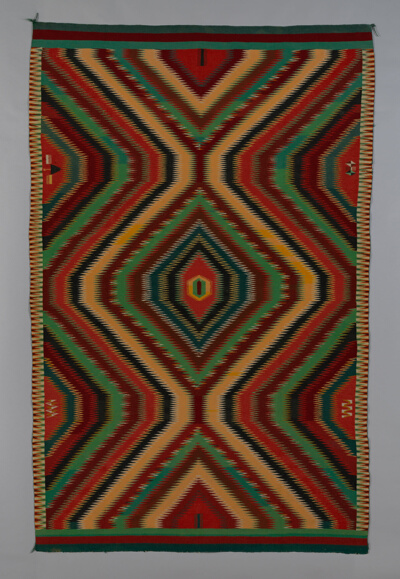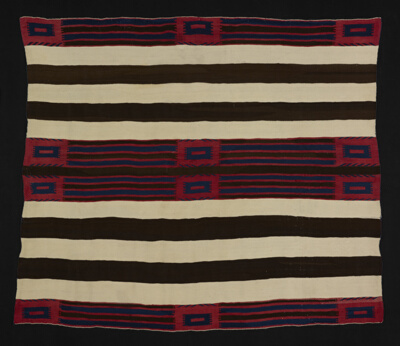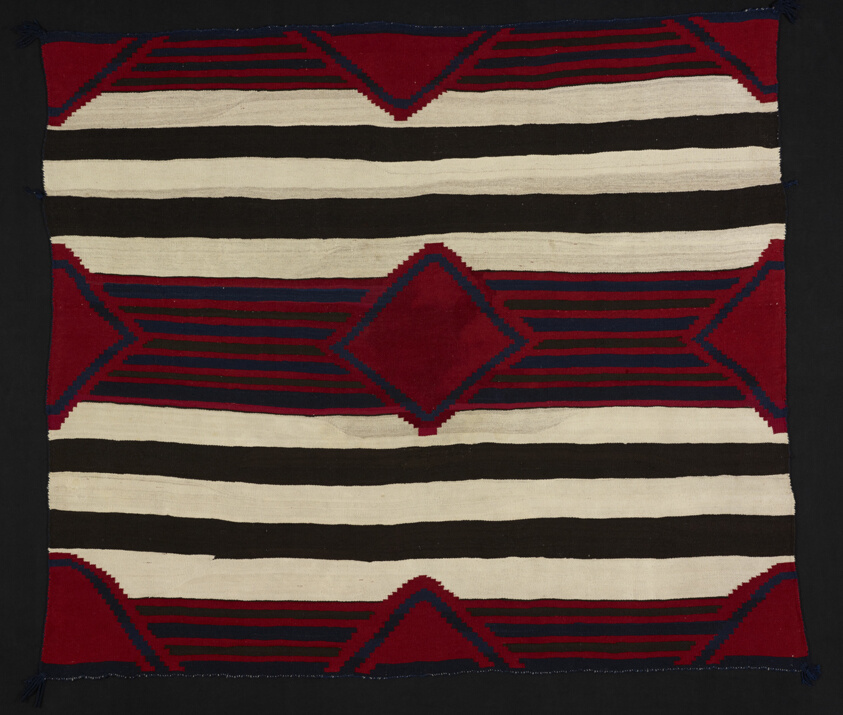
Chief Blanket (Third Phase)
Navajo (Diné) · c. 1860/65 · Art Institute of Chicago
What did you think?
Save this work’s image and museum information on this device to read without a connection.
Guide
Adjust the guideNew to it · Medium
Nobody has listened to this guide yet. Making it takes about twenty seconds, and after that anyone can hear it straight away.
From the museum
Navajo (Diné) blankets made using fine churro wool and natural dyes are valued as works of special artistic and cultural significance. The design of this blanket, which features a steeped diamond in the center, quarter-diamonds ar each corner, and half-diamonds in the center of each side, was first introduced during the 1860s. The stripes of white, black-brown, and red reflect the continued use of pattern elements typical of earlier blankets. Although such textiles are known as "chiefs' blankets," prominent men from tribes as far away as the Northern Plains, Southwest, and Great Basin wore them draped over their shoulders as a sign of their wealth and status. The Navajo believe that the deity Spider woman taught women how to weave and continues to work through today's artists by directing the growth and beauty of each textile they make. Finished blankets are thought to have life forces of their own, radiating a sense of vitality and harmony—essential to the Navajo philosophy of hozho in which every individual strives to live in balance with the world.
Ask about this work
Ask in your own words. The answer comes from what the museum has written about the work, and says so when that does not hold it.
Details
- Maker
- Navajo (Diné), Arizona, New Mexico, and Utah, United States
- Date
- c. 1860/65
- Medium
- Wool, single interlocking tapestry weave; twined edges; corner tassels
- Dimensions
- 149.6 × 173.9 cm (58 7/8 × 68 1/2 in.)
- Place of origin
- Navajo Nation, Arizona, New Mexico, & Utah
- Held by
- Art Institute of Chicago, Chicago · Not on view
- Credit line
- Robert Allerton Endowment
Image: Art Institute of Chicago, CC0