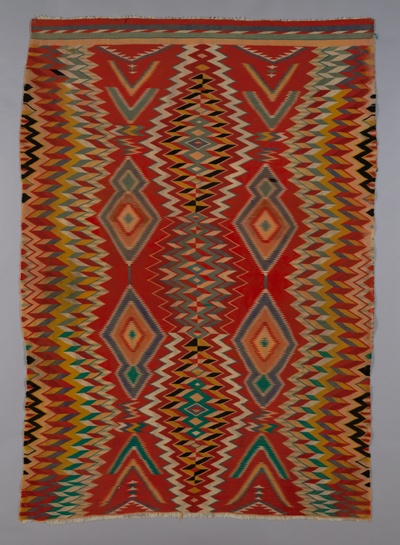
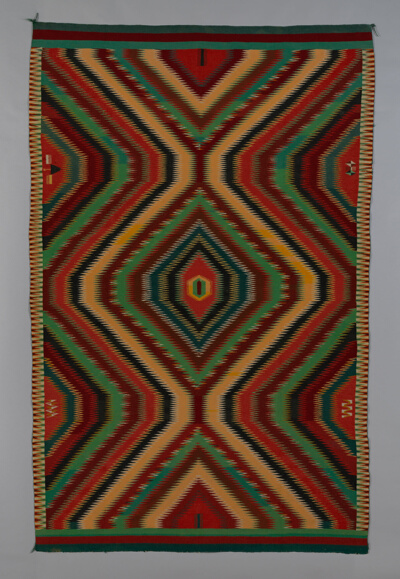
"Eye-Dazzler" Weaving
Navajo (Diné) · 1880/1900 · Art Institute of Chicago
Guide
Adjust the guideNew to it · Medium
Looking for this guide.
From the museum
Navajo weavers, most of whom were women, developed a new, more colorful and complex style of weaving in the late 19th century: they began incorporating wool yarns that had been dyed with vibrant commercial dyes, made available through expanded railroads. They often rendered the junctures between colors as serrated, zigzag lines, creating dynamic patterns that visually vibrate. For this reason, these textiles have come to be called “eye dazzlers.”
The museum’s own description, in English. Licence: CC BY 4.0
What did you think?
Save this work’s image and museum information on this device to read without a connection.
Ask about this work
Ask in your own words. The answer comes from what the museum has written about the work, and says so when that does not hold it.
Details
- Maker
- Navajo (Diné), Arizona, New Mexico, and Utah, United States
- Date
- 1880/1900
- Medium
- Cotton and wool, single interlocking tapestry weave; twined selvages and heading, overcast finish terminating in tassels
- Dimensions
- 214.5 × 155.7 cm (84 1/2 × 61 1/4 in.)
- Place of origin
- Navajo
- Held by
- Art Institute of Chicago, Chicago · Not on view
- Credit line
- Gift of Mrs. William Bross Lloyd
Image: Art Institute of Chicago, CC0