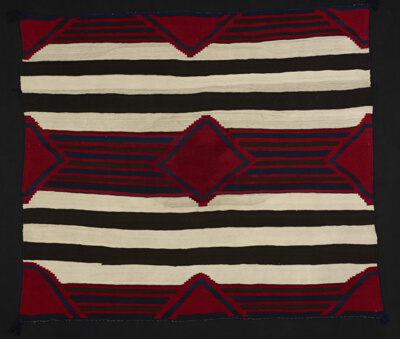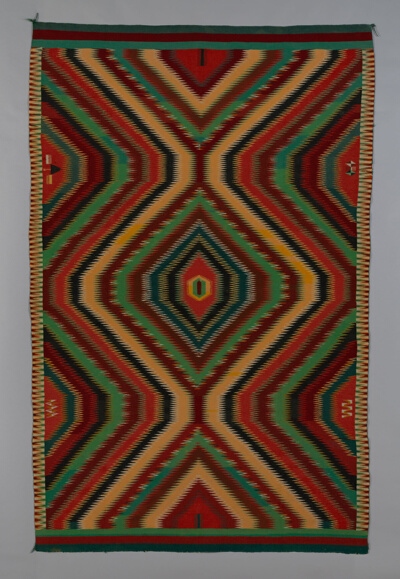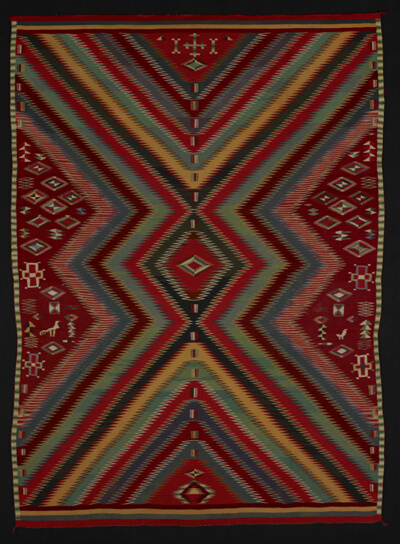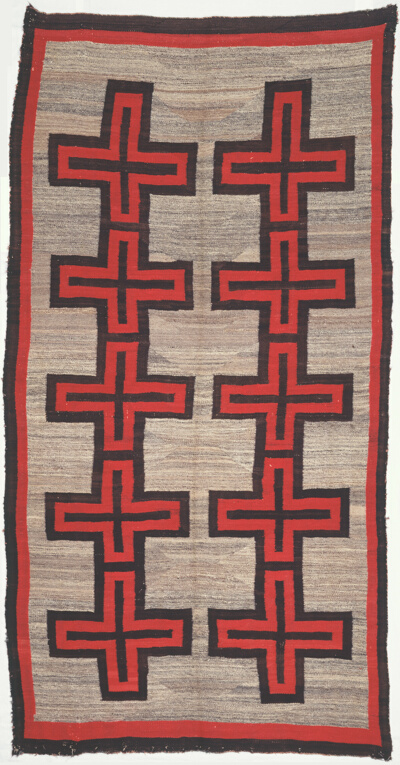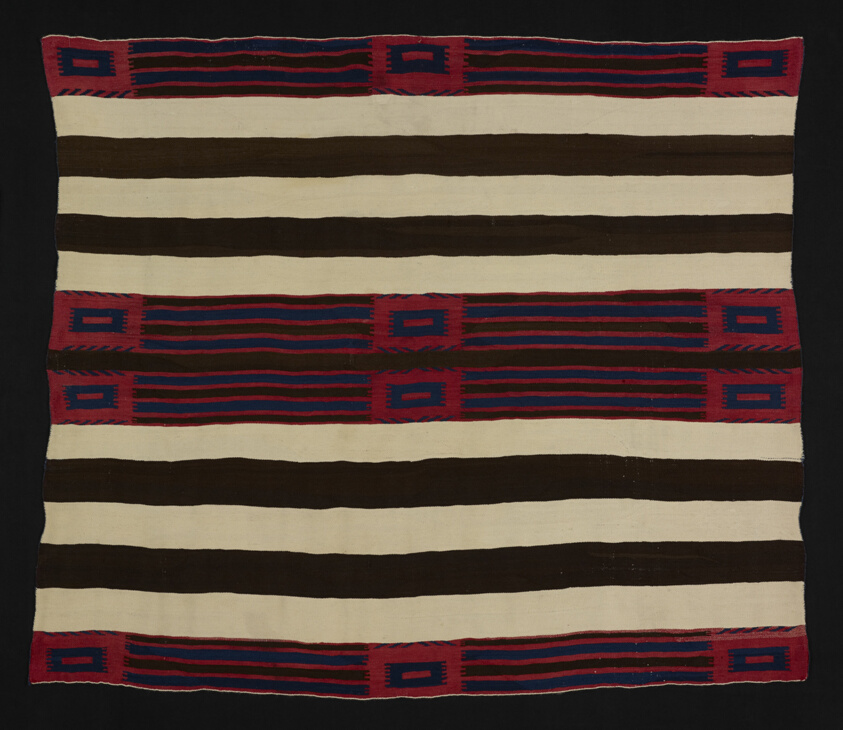
Wearing Blanket (Second Phase)
Navajo (Diné) · 1850-65 · Art Institute of Chicago
What did you think?
Guide
Adjust the guideNew to it · Medium
Nobody has listened to this guide yet. Making it takes about twenty seconds, and after that anyone can hear it straight away.
From the museum
According to Navajo (Diné) legend, the deity Spider Woman taught women to weave. Since that time, textiles have been thought to have a life force of their own that lies in the very processes of weaving. Ideally, finished blankets are supposed to radiate a sense of vitality. In creating a weaving, the artist participates inhozho, the Navajo concept of beauty and harmony. Made using fine churro wool and natural dyes, this warm and waterproof blanket was valued as a work of special artistic significance and as a prestige trade item. By the early 1830s, "chief" blankets were prized by prominent men among tribes as far away as the Northern Plains, Southwest, and Great Basin. The design of "chief" blankets evolved in an identifiable pattern. Phase I, dated from the early 19th century, is characterized by alternating broad horizontal stripes of white, black-brown, red, and indigo blue. Phase II innovations appeared by 1850, as Navajo weavers incorporated small red blocks into the ends and centers of the blue stripes. Phase III emerged by the 1860s. Blankets made at this time typically display a full terraced diamond in the center, quarter diamonds at each corner, and half diamonds in the center of each edge. The stripes of white, black-brown, red, and indigo blue were retained. By the late 1970s, a wide range of designs began to appear, as traders introduced textile models from Mexico and the Near East. Weaving remains a vital aspect of Navajo culture, in which women function as artists. In a religious sense, Spider Woman continues to work through these weavers, directing the growth and beauty of every blanket or rug.
The museum’s own description, in English. Licence: CC BY 4.0
Ask about this work
Ask in your own words. The answer comes from what the museum has written about the work, and says so when that does not hold it.
Details
- Maker
- Navajo (Diné), Arizona, New Mexico, and Utah, United States
- Date
- 1850-65
- Medium
- Wool; single interlocking tapestry weave; twined edges
- Dimensions
- 146 × 173.5 cm (57 1/2 × 68 1/4 in.)
- Place of origin
- Navajo
- Held by
- Art Institute of Chicago, Chicago · Not on view
- Credit line
- Louise Benton Wagner Endowment
Image: Art Institute of Chicago, CC0