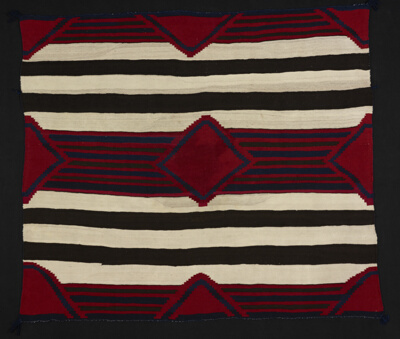
Wearing Blanket
Navajo (Diné) · 1860-90 · Art Institute of Chicago
Guide
Adjust the guideNew to it · Medium
Looking for this guide.
From the museum
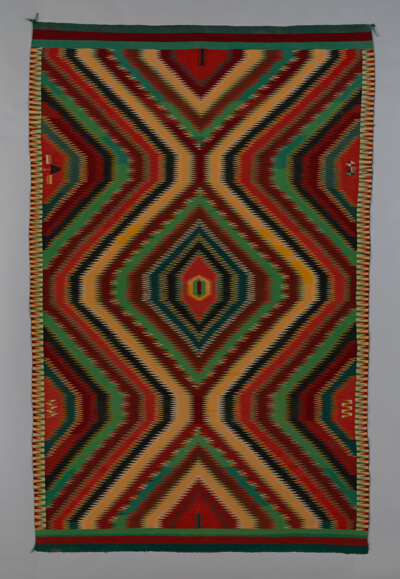
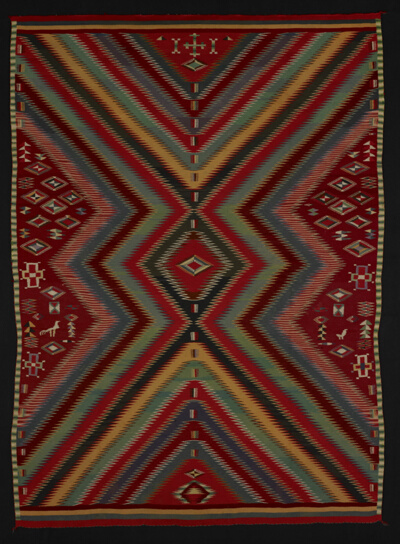
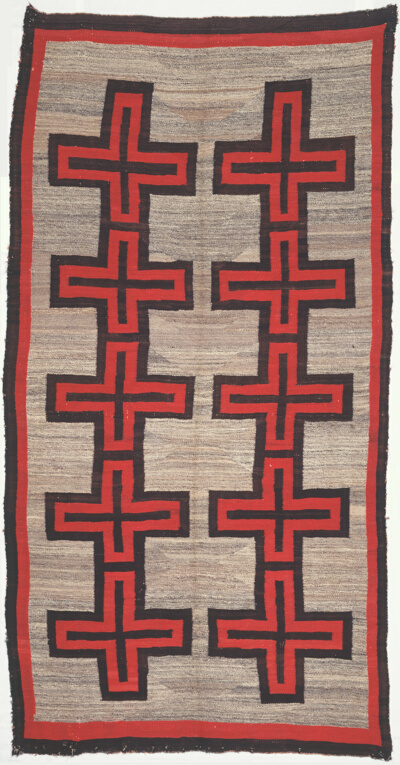
The Diné trace their knowledge of weaving and design to two holy people: Spider Man, who created the vertical loom, and Spider Woman, who taught them how to weave. These blankets typically were worn around both shoulders or wrapped around the torso with one end draped over one shoulder. Designs started with simple banded horizontal stripes and became increasingly complex over time. The predominantly geometric patterns of wearing blankets manifest the essential Diné concept of hózhó: the harmony and order that come through a balance of apparent opposites, such as day and night, which permeates the world.
The museum’s own description, in English. Licence: CC BY 4.0
What did you think?
Save this work’s image and museum information on this device to read without a connection.
Ask about this work
Ask in your own words. The answer comes from what the museum has written about the work, and says so when that does not hold it.
Details
- Maker
- Navajo (Diné), Arizona, New Mexico, and Utah, United States
- Date
- 1860-90
- Medium
- Wool, plain weave with "lazy lines" and dovetail tapestry weave; twined warp ends and selvages; knotted corner tassels
- Dimensions
- 177.8 × 125.4 cm (70 × 49 3/8 in.)
- Place of origin
- Navajo Nation, Arizona, New Mexico, & Utah
- Held by
- Art Institute of Chicago, Chicago · Not on view
- Credit line
- Bequest of Alan R. Brodie
Image: Art Institute of Chicago, CC0