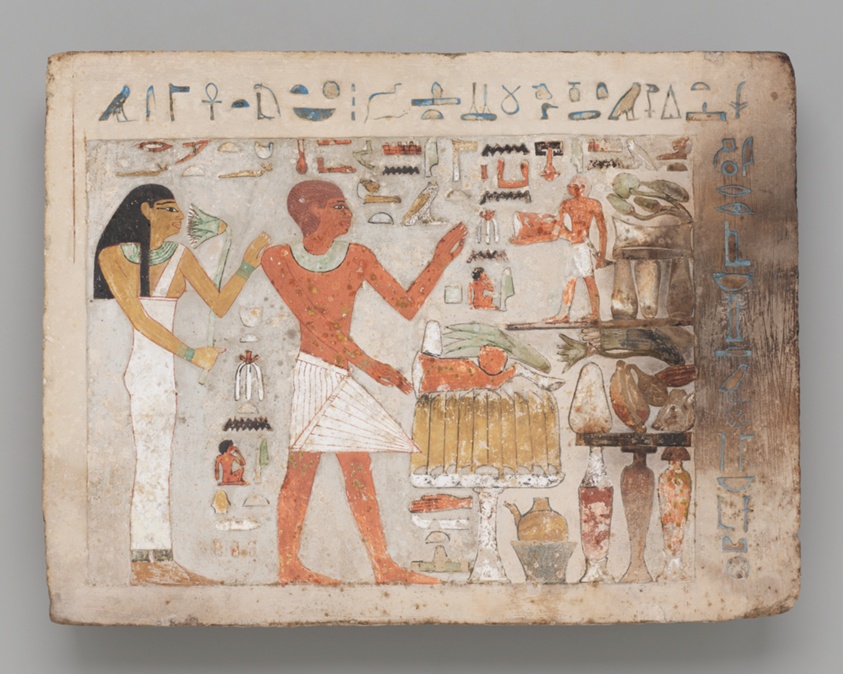
Stela of Amenemhat and Hemet
Ancient Egyptian · Middle Kingdom, early Dynasty 12, about 1956–1877 BCE · Art Institute of Chicago
What did you think?
Guide
4 chapters · about 2 minAdjust the guideNew to it · Medium
A Couple Remembered
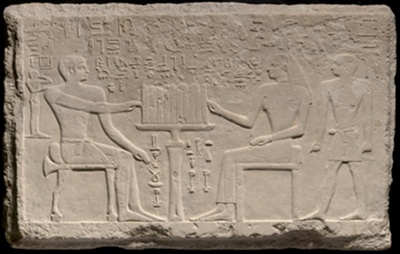
This small stone slab, called a stela, is made of limestone with paint on top. It is about 31 centimeters high and 42 centimeters wide, so you could hold it in your arms. It was made to commemorate a man named Amenemhat and his wife, Hemet, for all eternity. They stand on the left side. In front of them are two offering tables piled with food. Their son appears much smaller in the upper right. Hieroglyphs, which are the picture signs of ancient Egyptian writing, fill the space around the figures and run along the top and right edge.
Where to Look
Start with the two figures on the left. Notice that Amenemhat's skin is dark reddish brown, while Hemet's is yellow. Then look at how each body is built. The heads are in profile, but the shoulders face you straight on, and then the chest and legs turn to the side again. Finally, find the border along the top and right edge. Its hieroglyphs are cut into the stone and painted blue, while the signs inside the scene stand out from the surface in bright colors.
Carved, Then Painted
This stela was made in the Middle Kingdom, early in the Twelfth Dynasty, about 1956 to 1877 BCE. It was probably made in Thebes, which is now Luxor. The artist first sculpted it in two kinds of carving. In raised relief, the figures stand out from the background. In sunken relief, they are cut down into the stone. Only afterward were some surfaces painted in black, brown, green, yellow, and white. The paint was a mixture of pigment and tempera. The artist's aim was to preserve the essential parts of his subjects forever.
Food for Eternity
Every choice here carries meaning. The left side was the place of honor, so Amenemhat and Hemet are shown there. He stands in front of his wife, which marks him as head of the household. His darker skin suggests an active life outdoors, while her paler color suggests the home, which was her realm. The hieroglyphs name the couple, give their family line, and speak offerings. The Egyptians believed food could be real, pictured, written, or spoken in prayer. Look once more at the tables of food, and the painted words around them.
This guide was written by AI from the description published by Art Institute of Chicago. Licence: CC BY 4.0
Ask about this work
Ask in your own words. The answer comes from what the museum has written about the work, and says so when that does not hold it.
Details
- Maker
- Egyptian; probably Thebes (now Luxor), Egypt
- Date
- Middle Kingdom, early Dynasty 12, about 1956–1877 BCE
- Medium
- Limestone and pigment
- Dimensions
- 31.1 × 41.7 × 6.7 cm (12 1/4 × 16 3/8 × 2 5/8 in.)
- Place of origin
- Egypt
- Held by
- Art Institute of Chicago, Chicago · On view · Gallery 50
- Credit line
- Museum Purchase Fund
Image: Art Institute of Chicago, CC0
More by Ancient Egyptian
GuideCoffin and Mummy of PaankhaenamunAncient Egyptian · Third Intermediate Period, Dynasty 22, reign of Osorkon I (about 924–889 BCE)
Fragment of a Stela of NeferhotepAncient Egyptian · New Kingdom, mid-Dynasty 19, about 1240-1195 BCE
Tomb Wall Fragment Depicting DonkeysAncient Egyptian · Old Kingdom, late Dynasty 5, about 2375 BCE
Canopic Jar of AmenhotepAncient Egyptian · New Kingdom, Dynasty 18, reign of Amenhotep II (about 1427–1400 BCE)