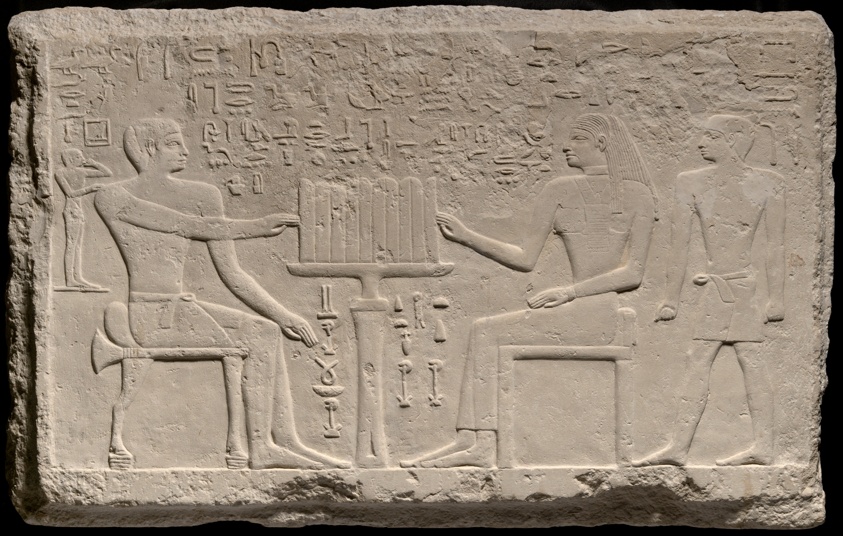
Stela of Tjenti and Nefret
Ancient Egyptian · Old Kingdom, Dynasty 4, about 2540 BCE · Art Institute of Chicago
What did you think?
Guide
Adjust the guideNew to it · Medium
Nobody has listened to this guide yet. Making it takes about twenty seconds, and after that anyone can hear it straight away.
From the museum
Seated on a cushioned chair, an official named Tjenti extends his hand toward a table covered in tall loaves of bread. His wife, Nefret, strikes a similar pose opposite him. Scenes depicting families around a table laden with food for the afterlife were a standard decoration in ancient Egyptian tombs for generations. Displayed in chapels where descendants gathered to remember the dead, these images were eternal family portraits, ensuring an afterlife populated with loved ones. Here, Tjenti and Nefret are shown with their son Tjenti (standing on the right) and granddaughter Nefer-Hathor, who holds her index finger to her lips in a gesture symbolic of childhood. Following Egyptian artistic conventions, the figures are represented at different scales that denote their status within the family.
Ask about this work
Ask in your own words. The answer comes from what the museum has written about the work, and says so when that does not hold it.
Details
- Maker
- Egyptian; probably tomb G 3035, Giza, Egypt
- Date
- Old Kingdom, Dynasty 4, about 2540 BCE
- Medium
- Limestone
- Dimensions
- 55.9 × 87.6 × 11.4 cm (22 × 34 1/2 × 4 1/2 in.)
- Place of origin
- Egypt
- Held by
- Art Institute of Chicago, Chicago · On view · Gallery 50
- Credit line
- Museum Purchase Fund
Image: Art Institute of Chicago, CC0
More by Ancient Egyptian
GuideCoffin and Mummy of PaankhaenamunAncient Egyptian · Third Intermediate Period, Dynasty 22, reign of Osorkon I (about 924–889 BCE)
GuideStela of Amenemhat and HemetAncient Egyptian · Middle Kingdom, early Dynasty 12, about 1956–1877 BCE
Fragment of a Stela of NeferhotepAncient Egyptian · New Kingdom, mid-Dynasty 19, about 1240-1195 BCE
Tomb Wall Fragment Depicting DonkeysAncient Egyptian · Old Kingdom, late Dynasty 5, about 2375 BCE