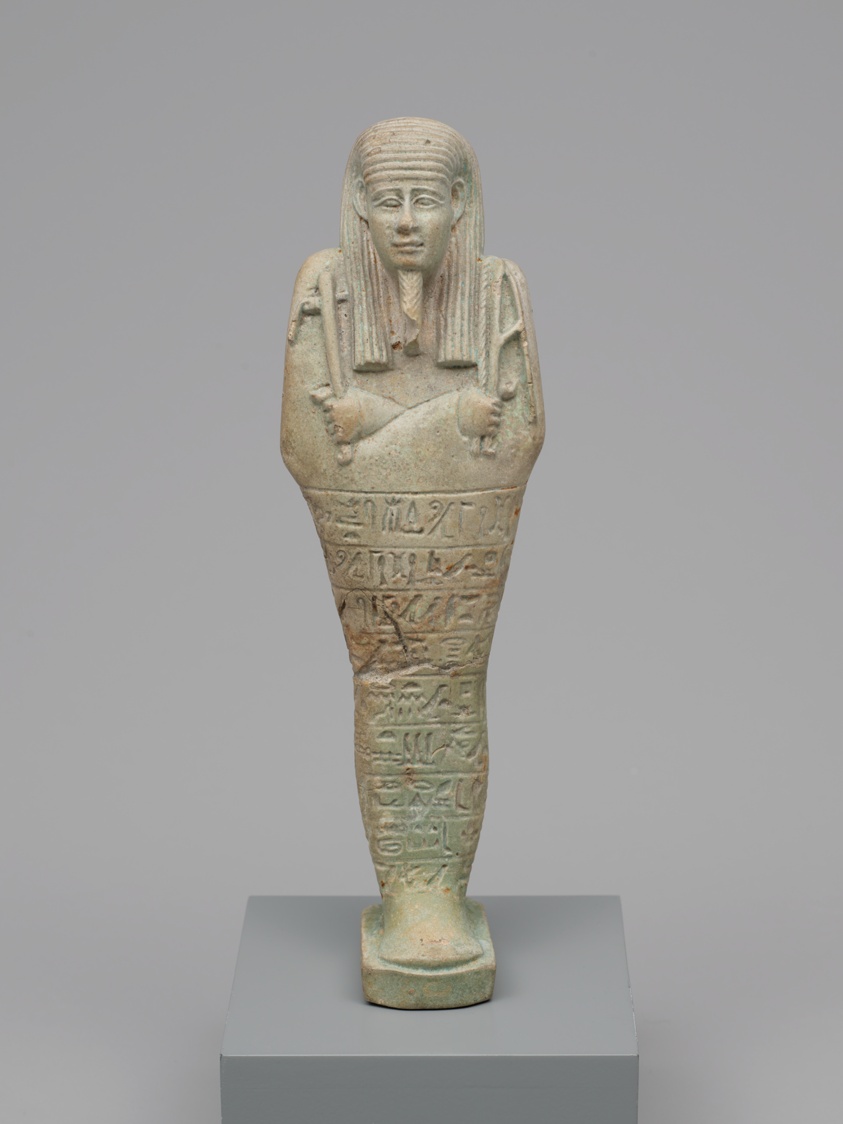
Ushabti (Funerary Figurine) of Horudja
Ancient Egyptian · Late Period, Dynasty 30 (380–343 BCE) · Art Institute of Chicago
What did you think?
Guide
Adjust the guideNew to it · Medium
Nobody has listened to this guide yet. Making it takes about twenty seconds, and after that anyone can hear it straight away.
From the museum
To assure themselves a comfortable afterlife, Egyptians stocked their tombs with at least one figurine called an ushabti, who acted as a servant in the afterlife. The message carved on each of the figurines explained that if the deceased is called on to do any work in the afterlife, the ushabti will respond with “Here I am” and will do the job. Some tombs had as many as one ushabti for every day of the year and another 36 overseers to keep order. All but the poorest citizens provided themselves with some kind of funerary furnishings. Products for burial and the labor to produce them made up a large industry in Egypt.
The museum’s own description, in English. Licence: CC BY 4.0
Ask about this work
Ask in your own words. The answer comes from what the museum has written about the work, and says so when that does not hold it.
Details
- Maker
- Egyptian; Hawara, Egypt
- Date
- Late Period, Dynasty 30 (380–343 BCE)
- Medium
- Faience
- Dimensions
- 21.9 × 6.6 × 4.7 cm (8 5/8 × 2 5/8 × 1 7/8 in.)
- Place of origin
- Egypt
- Held by
- Art Institute of Chicago, Chicago · On view · Gallery 50
- Credit line
- Gift of Miss Amelia B. Edwards
Image: Art Institute of Chicago, CC0
More by Ancient Egyptian
GuideCoffin and Mummy of PaankhaenamunAncient Egyptian · Third Intermediate Period, Dynasty 22, reign of Osorkon I (about 924–889 BCE)
GuideStela of Amenemhat and HemetAncient Egyptian · Middle Kingdom, early Dynasty 12, about 1956–1877 BCE
Fragment of a Stela of NeferhotepAncient Egyptian · New Kingdom, mid-Dynasty 19, about 1240-1195 BCE
Tomb Wall Fragment Depicting DonkeysAncient Egyptian · Old Kingdom, late Dynasty 5, about 2375 BCE